Thicklip wrasse
Hemigymnus melapterus
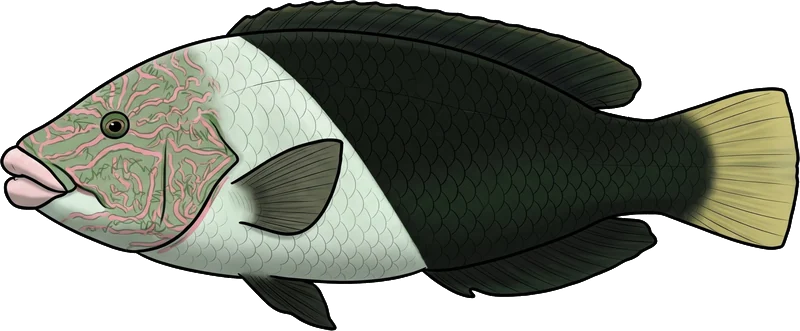
Illustration: Bloom by Day
A big wrasse cut diagonally in two: pale green-white in front, near-black behind, with scribbled lines over the face and a pair of conspicuously thick lips. It takes mouthfuls of sand and blows them out through its gills, which is the surest way to find one.
how to recognise it
- adults are split on a diagonal between the start of the dorsal fin and the start of the anal fin: whitish to pale green in FRONT, blackish to dark green BEHIND
- a pattern of scribbles and lines on the head
- thick lips
- juveniles are greenish-brown with a diagonal white bar behind the pectoral fin
- often seen taking a mouthful of sand and blowing it out through the gill openings
Field marks read from Fishes of Australia, 2026-10-16. Our wording, their facts. Max size 45 cm TL.
facts
- habitat
- reef
- size
- ~30 cm, to 45 cm
Max size from Fishes of Australia (45 cm TL); the typical size is Bluebird’s, not from a cited source
- records
- 1358 at 8 spot(s), none of
them in this region
Recorded at Cod Hole (Ribbon Reefs GBR), Low Isles (Port Douglas), Green Island (Cairns), Fitzroy Island (Cairns), Great Keppel Island (West), Erskine Island, Lady Musgrave Island, Lady Elliot Island (GBR). A count of occurrence records, not abundance. Records are where someone looked.
when it has been recorded
JFMAMJJASOND
A gap means no record in the sample, not absence.
the rule
no QLD rule listed — check before you dive
no NSW rule listed — check before you dive
no closed season recorded for this species — that is not the same as open; check the official page
Rules checked 2026-10-13 against qld.gov.au
Rules change. Check before you dive.
Occurrence data: Atlas of Living Australia (ala.org.au), CC-BY 4.0.
Diver transect counts: Reef Life Survey (reeflifesurvey.com), CC-BY 4.0, supplied via ALA.
Target and protected species: Queensland tidal-water size and possession limits (qld.gov.au) and NSW saltwater bag and size limits plus threatened species lists (dpird.nsw.gov.au).
Habitat and size: Bluebird, approximate, from general knowledge. Not cited. FishBase is CC BY-NC and this app is commercial, so it is not used.
Description written for Bloom. RECORDS ARE WHERE SOMEONE LOOKED, NOT WHERE THE FISH ARE. A record count is a count of records near here and nothing else -- it is not abundance, and a species with few records is not rare. Absence of records is not absence of fish.