Staghorn damsel
Amblyglyphidodon curacao
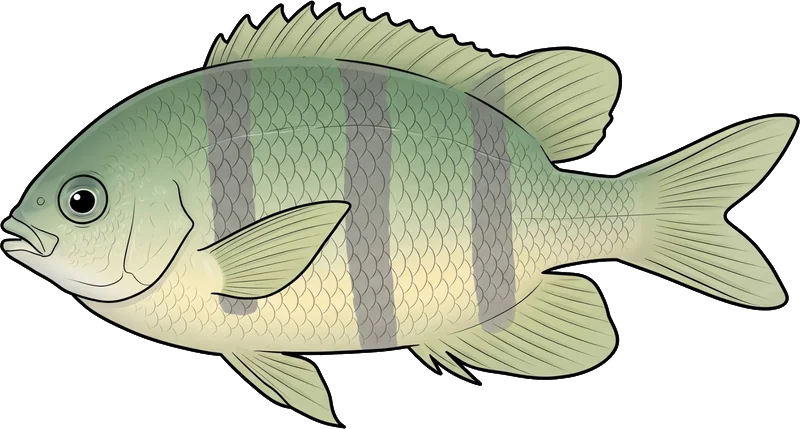
Illustration: Bloom by Day
A small green-yellow damselfish crossed by three broad grey bars, with a forked tail. It hovers in the water just above staghorn coral in small groups and drops straight down into the branches the moment anything comes at it.
how to recognise it
- greenish to yellowish
- three broad greyish bars on the sides
- a forked tail
- small: about 11 cm
Field marks read from Fishes of Australia, 2026-10-16. Our wording, their facts. Max size 11 cm TL.
facts
- habitat
- reef
- size
- ~9 cm, to 11 cm
Max size from Fishes of Australia (11 cm TL); the typical size is Bluebird’s, not from a cited source
- records
- 1655 at 8 spot(s), none of
them in this region
Recorded at Cod Hole (Ribbon Reefs GBR), Low Isles (Port Douglas), Green Island (Cairns), Fitzroy Island (Cairns), Bait Reef (Whitsundays), Hayman Island — Blue Pearl Bay, Hook Island — Manta Ray Bay, Flinders Reefs (Coral Sea). A count of occurrence records, not abundance. Records are where someone looked.
when it has been recorded
JFMAMJJASOND
A gap means no record in the sample, not absence.
the rule
no QLD rule listed — check before you dive
no NSW rule listed — check before you dive
no closed season recorded for this species — that is not the same as open; check the official page
Rules checked 2026-10-13 against qld.gov.au
Rules change. Check before you dive.
Occurrence data: Atlas of Living Australia (ala.org.au), CC-BY 4.0.
Diver transect counts: Reef Life Survey (reeflifesurvey.com), CC-BY 4.0, supplied via ALA.
Target and protected species: Queensland tidal-water size and possession limits (qld.gov.au) and NSW saltwater bag and size limits plus threatened species lists (dpird.nsw.gov.au).
Habitat and size: Bluebird, approximate, from general knowledge. Not cited. FishBase is CC BY-NC and this app is commercial, so it is not used.
Description written for Bloom. RECORDS ARE WHERE SOMEONE LOOKED, NOT WHERE THE FISH ARE. A record count is a count of records near here and nothing else -- it is not abundance, and a species with few records is not rare. Absence of records is not absence of fish.