King threadfin
Polydactylus macrochir
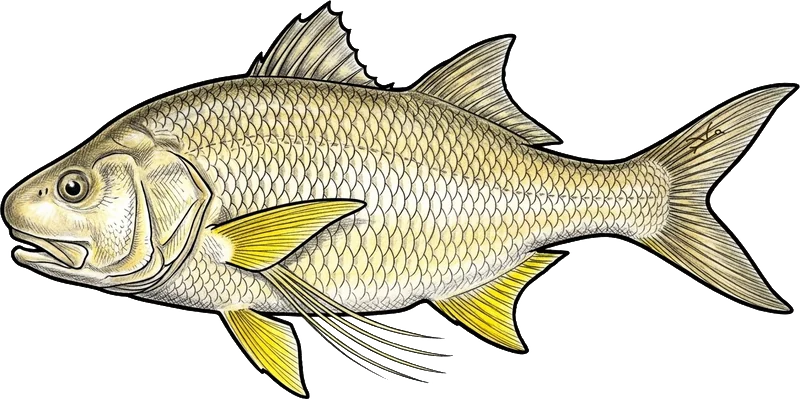
Illustration: Bloom by Day
The giant of the threadfins, plain silver-bronze with no spots or stripes and one enormous fourth filament nearly half its own body length. It haunts muddy river mouths and mangrove creeks, mostly alone once large.
how to recognise it
- the body is plain: no spots and no stripes
- the fourth pectoral filament is very long — 40 to 53% of the body length
- the second dorsal spine is noticeably more robust than the rest
- a big fish for an estuary: to about 1.7 m
don’t confuse with
- Blue threadfin — the blue threadfin has FOUR filaments, the upper one longest and only reaching the pelvic-fin base, with white filaments and a yellow-edged pelvic fin
Field marks read from FishBase, 2026-10-15. Our wording, their facts. Max size 170 cm FL.
facts
- habitat
- estuary
- size
- ~50 cm, to 170 cm
Max size from FishBase (170 cm FL); the typical size is Bluebird’s, not from a cited source
- records
- 81 at 9 spot(s), none of
them in this region
Recorded at Hinchinbrook Island — Ramsay Bay, Magnetic Island — Geoffrey Bay, Cid Harbour (Whitsunday — West), Pioneer Rocks (Whitsundays), Fraser Island — 75-Mile Beach, Woorim Beach (Bribie Is. — East), Pumicestone Passage (Bribie — West), Redcliffe Jetty, Dunwich Jetty (N Stradbroke — Bay). A count of occurrence records, not abundance. Records are where someone looked.
when it has been recorded
JFMAMJJASOND
A gap means no record in the sample, not absence.
the rule
QLD — Min: 65cm · Limit: 5
source
· verified 2026-10-10
no NSW rule listed — check before you dive
no closed season recorded for this species — that is not the same as open; check the official page
Rules checked 2026-10-13 against qld.gov.au
Rules change. Check before you dive.
Occurrence data: Atlas of Living Australia (ala.org.au), CC-BY 4.0.
Diver transect counts: Reef Life Survey (reeflifesurvey.com), CC-BY 4.0, supplied via ALA.
Target and protected species: Queensland tidal-water size and possession limits (qld.gov.au) and NSW saltwater bag and size limits plus threatened species lists (dpird.nsw.gov.au).
Habitat and size: Bluebird, approximate, from general knowledge. Not cited. FishBase is CC BY-NC and this app is commercial, so it is not used.
Description written for Bloom. RECORDS ARE WHERE SOMEONE LOOKED, NOT WHERE THE FISH ARE. A record count is a count of records near here and nothing else -- it is not abundance, and a species with few records is not rare. Absence of records is not absence of fish.