Giant trevally
Caranx ignobilis
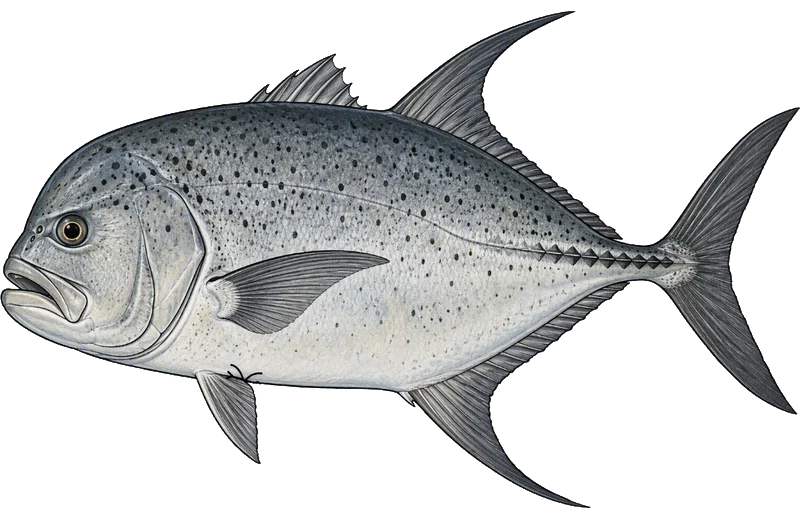
Illustration: Bloom by Day
A deep silver slab with a blunt, almost vertical forehead and a tail that looks too small for the body until it uses it. They come in fast and low over the sand, turn once to size you up, and either leave or start working the bait around you.
how to recognise it
- a steep, blunt head profile
- heavy bony scutes along the straight rear part of the lateral line
- NO dark spot on the rear of the gill cover
- silvery to dusky gold, sometimes almost black
don’t confuse with
- Silver trevally — silver trevally is slimmer, greenish-blue above with a diffuse dark spot on the top of the gill cover, and young ones have a yellow side stripe
- Golden trevally — the golden trevally has black spots or blotches scattered on a silvery-grey side; juveniles are bright yellow with black bars
- Bluefin trevally — the bluefin trevally has electric-blue second dorsal, anal and tail fins and many small blue and black spots
- Island trevally — the island trevally has a few large elliptical yellow spots on the midside and blue fins
Field marks read from Fishes of Australia, 2026-10-13. Our wording, their facts. Max size 180 cm TL; 86.6 kg.
facts
- habitat
- reef
- size
- ~80 cm, to 180 cm
Max size from Fishes of Australia (180 cm TL; 86.6 kg); the typical size is Bluebird’s, not from a cited source
- records
- 80 at 3 spot(s), none of
them in this region
Recorded at SS Yongala Wreck, Hardy Reef (Whitsundays), Flinders Reefs (Coral Sea). A count of occurrence records, not abundance. Records are where someone looked.
when it has been recorded
JFMAMJJASOND
A gap means no record in the sample, not absence.
the rule
QLD — None · Combined limit: 20 in total of all trevally species
source
· verified 2026-10-10
no NSW rule listed — check before you dive
no closed season recorded for this species — that is not the same as open; check the official page
Rules checked 2026-10-13 against qld.gov.au
Rules change. Check before you dive.
Occurrence data: Atlas of Living Australia (ala.org.au), CC-BY 4.0.
Diver transect counts: Reef Life Survey (reeflifesurvey.com), CC-BY 4.0, supplied via ALA.
Target and protected species: Queensland tidal-water size and possession limits (qld.gov.au) and NSW saltwater bag and size limits plus threatened species lists (dpird.nsw.gov.au).
Habitat and size: Bluebird, approximate, from general knowledge. Not cited. FishBase is CC BY-NC and this app is commercial, so it is not used.
Description written for Bloom. RECORDS ARE WHERE SOMEONE LOOKED, NOT WHERE THE FISH ARE. A record count is a count of records near here and nothing else -- it is not abundance, and a species with few records is not rare. Absence of records is not absence of fish.