Darkspot tuskfish
Choerodon monostigma
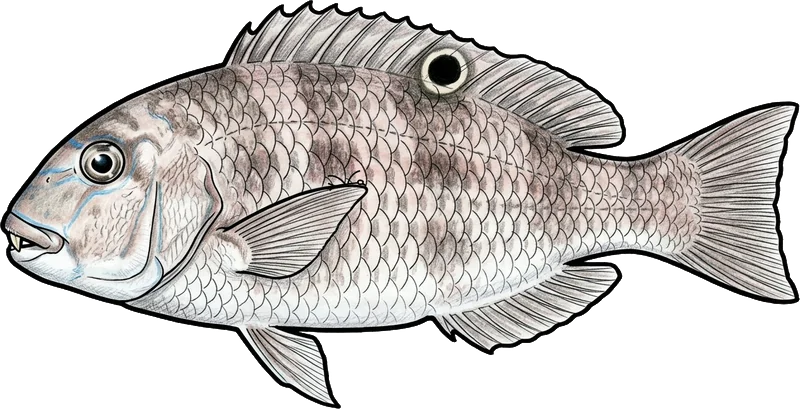
Illustration: Bloom by Day
Mottled pink-brown with blue lines on the snout and around the eye, and a single ringed black spot sitting in the middle of the dorsal fin — on the FIN, not the body. It hangs over rubble bottoms in the deeper part of the reef and is unhurried about moving.
how to recognise it
- a prominent black spot with a pale ring around it ON THE MIDDLE OF THE DORSAL FIN
- blue lines on the snout and around the eye
- pale greyish, pinkish or mottled brown, whitish below
- often indistinct broad dusky bands on the upper sides
don’t confuse with
- Redstripe tuskfish — the redstripe's dark mark is a stripe along the BODY ending in a spot at the tail base
- Wedgetail tuskfish — the wedgetail's mark is a slash above the pectoral-fin base
- Gomon's tuskfish — Gomon's tuskfish has a broad white midside stripe and a diffuse reddish-brown spot on the BACK, not on the fin
- Bridled tuskfish — the bridled tuskfish has blue diagonal stripes on the snout and under the eye, and no spot on the dorsal fin
Field marks read from Fishes of Australia, 2026-10-15. Our wording, their facts. Max size 25 cm TL.
facts
- habitat
- reef
- size
- ~18 cm, to 25 cm
Max size from Fishes of Australia (25 cm TL); the typical size is Bluebird’s, not from a cited source
- records
- 13 at 6 spot(s), none of
them in this region
Recorded at Green Island (Cairns), Fitzroy Island (Cairns), Magnetic Island — Geoffrey Bay, Cid Harbour (Whitsunday — West), Pioneer Rocks (Whitsundays), Cairns Reef (Great Barrier). A count of occurrence records, not abundance. Records are where someone looked.
when it has been recorded
JFMAMJJASOND
A gap means no record in the sample, not absence.
the rule
QLD — Min: 30cm · Combined limit: 6 in total of all tuskfish species
source
· verified 2026-10-10
no NSW rule listed — check before you dive
no closed season recorded for this species — that is not the same as open; check the official page
Rules checked 2026-10-13 against qld.gov.au
Rules change. Check before you dive.
Occurrence data: Atlas of Living Australia (ala.org.au), CC-BY 4.0.
Diver transect counts: Reef Life Survey (reeflifesurvey.com), CC-BY 4.0, supplied via ALA.
Target and protected species: Queensland tidal-water size and possession limits (qld.gov.au) and NSW saltwater bag and size limits plus threatened species lists (dpird.nsw.gov.au).
Habitat and size: Bluebird, approximate, from general knowledge. Not cited. FishBase is CC BY-NC and this app is commercial, so it is not used.
Description written for Bloom. RECORDS ARE WHERE SOMEONE LOOKED, NOT WHERE THE FISH ARE. A record count is a count of records near here and nothing else -- it is not abundance, and a species with few records is not rare. Absence of records is not absence of fish.