Australian sardine
Sardinops sagax
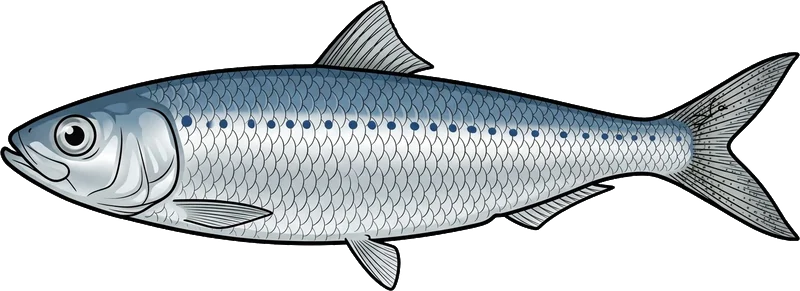
Illustration: Bloom by Day
A steely-blue sardine with one neat row of dark blue spots along the line where the back meets the silver. It schools in open water in huge numbers and is the bait at the centre of most of the feeding you will ever see from a boat.
how to recognise it
- one row of evenly spaced small dark blue spots along the line where the blue back meets the silver side
- steely-blue above, silvery on the sides and belly
- fine black spots on the outer margins of the dorsal and tail fins
don’t confuse with
- Common hardyhead — the hardyhead has no row of side spots, but does have dark pectoral tips and a dark rear tail margin
- Australian anchovy — the anchovy has a broad silver side stripe and a snout overhanging its mouth, and no spots
- Dorab wolf herring — the wolf herring is a metre-long predator with dagger teeth; this is a sardine to 30 cm
Field marks read from Fishes of Australia, 2026-10-15. Our wording, their facts. Max size 30 cm TL.
facts
- habitat
- pelagic
- size
- ~18 cm, to 30 cm
Max size from Fishes of Australia (30 cm TL); the typical size is Bluebird’s, not from a cited source
- records near here
- 2 at 2 of 6 spots
A count of occurrence records near these spots, not abundance. Records are where someone looked.
when it has been recorded
JFMAMJJASOND
A gap means no record in the sample, not absence.
the rule
QLD — None · None
source
· verified 2026-10-10
NSW — no size limit · 100
source
· verified 2026-10-01
no closed season recorded for this species — that is not the same as open; check the official page
Rules checked 2026-10-13 against qld.gov.au
Rules change. Check before you dive.
Occurrence data: Atlas of Living Australia (ala.org.au), CC-BY 4.0.
Diver transect counts: Reef Life Survey (reeflifesurvey.com), CC-BY 4.0, supplied via ALA.
Target and protected species: Queensland tidal-water size and possession limits (qld.gov.au) and NSW saltwater bag and size limits plus threatened species lists (dpird.nsw.gov.au).
Habitat and size: Bluebird, approximate, from general knowledge. Not cited. FishBase is CC BY-NC and this app is commercial, so it is not used.
Description written for Bloom. RECORDS ARE WHERE SOMEONE LOOKED, NOT WHERE THE FISH ARE. A record count is a count of records near here and nothing else -- it is not abundance, and a species with few records is not rare. Absence of records is not absence of fish.